ONE:Notwithstanding his careless manner, however, there was much sincerity in the nature of Lord Melbourne; and there is no doubt that he laboured with an honest purpose to make his Administration useful to the country, though not with so much activity and energy, or with such constant solicitude to secure success, as his predecessor had brought to the task. As it was now advancing towards the end of the Session, he confined his attention to two great measures of reform¡ªthe Irish Tithe question (of which we have already disposed) and the question of Municipal Reform. It is scarcely necessary to remark that abuses in corporations had been a matter of constant and general complaint for two centuries. But it was hopeless to expect a remedy so long as the Parliamentary representation was so inadequate and corrupt. The rotten and venal boroughs, of which the franchise was abolished or amended by the Reform Act, were the chief seats of abuse. The correction of the local evil would have been the destruction of the system by which the ruling party in the State sustained its political power. There were, therefore, the most powerful interests at work, restraining each from attempting the work of reform; but by the Parliamentary Reform Act these interests were abolished, and those local fountains of corruption could no longer pour their fetid contents into the legislature. Statesmen now felt at liberty to abate those nuisances. Yet the work was not as speedily accomplished as might have been expected. It is true that Lord Grey advised the king to issue a commission of inquiry in July, 1833, but it was not until the 5th of June, 1835, that any measure was brought forward upon the subject. Even then Lord Melbourne had to overcome the dislike of the king, who distrusted the measure, and thought that, if the corporations were to be reformed at all, they had best be reformed by granting them new charters. The commission consisted of twenty gentlemen, who were to proceed with the utmost despatch to inquire as to the existing state of the municipal corporations in England and Wales, and to collect information respecting the defects in their constitution, to make inquiry into their jurisdiction and powers as to the administration of justice, and in all other[388] respects; and also into the mode of electing and appointing the members and officers of such corporations, into the privileges of the freemen and other members thereof, and into the nature and management of the income, revenues, and funds of the said corporations. They divided the whole of England and Wales into districts, each of which was assigned to two commissioners. Their reports on individual corporations occupied five folio volumes. The whole was presented in a general report, signed by sixteen of the Commissioners.Before leaving, the courteous officer permitted Bailly and about half-a-dozen deputies to enter and bring out their papers. The carpenters were already at work making preparations for the royal s¨¦ance, which was intended for a counter-manifestation, and as the body of the deputies, now nearly completing their six hundred, marched through the streets, they heard the heralds[361] proclaiming it for Monday, the 22nd. Bailly felt that there was more indignity intended than even that of turning them so unceremoniously out of their house, for a message had been sent to him from the king, announcing the s¨¦ance, but it had not been delivered to him, as etiquette required, at the hall, but at his private house, and not by a written dispatch, but verbally by De Br¨¦z¨¦, the master of ceremonies. When the deputies, with their president at their head, reached the Tennis Court, they found it a very spacious apartment, but naked, unfurnished, and desolate. There were no seats for the deputies, and a chair being offered to Bailly he declined it, saying he would not sit whilst the other members were standing. A wooden bench was brought, and served for a desk, two deputies were stationed as doorkeepers, and the keeper of the Court appeared and offered them his services. Great numbers of the populace crowded in, and the deliberations commenced. There were loud complaints of the interruption of their sitting, and many proposals to prevent such accidents in future. It was proposed to adjourn to Paris, where they would have the support of the people, and this project was received with enthusiasm; but Bailly feared that they might be attacked on the way, and, moreover, that such a measure would give an advantage to their enemies, looking like a desertion of their ground. Mounier then proposed that the deputies should bind themselves by an oath never to separate till they had completed the Constitution. This was hailed with enthusiasm. The oath was drawn up, and Bailly, standing on the bench, read it aloud:¡ª"You solemnly swear never to separate, and to re-assemble whenever circumstances shall require it, until the Constitution of the kingdom is founded and established on a solid basis." As he read this all the deputies held up their right hands, and repeated after him the words, "We swear!" The formula was read so loud that not only the spectators within but numbers without heard it, and all joined in the cry, "We swear!" Then followed loud acclaims of "Vive l'Assembl¨¦e!" "Vive le Roi!"
ONE:While this was going on, the town of San Sebastian was stormed by the British. Sir Thomas Graham conducted the assault, which was led on by the brigade of General Robinson, bravely supported by a detachment of Portuguese under Major Snodgrass. The place was captured; the French were driven through it to the castle standing on a height, in which they found refuge. Seven hundred prisoners were taken. The British lost two thousand men in the assault¡ªa loss which would have been far greater had a mine, containing one thousand two hundred pounds of gunpowder, exploded, but which was fortunately prevented by the falling in of a saucisson. Many less would have fallen, however, had General Graham allowed shells to be thrown into the town, which he would not, on account of the inhabitants. But the French had not only prepared this great mine, but exploded various other appliances for setting the town on fire. In fact they showed no care for the people or the town. When driven to the castle, after a murderous street fight¡ªin which they picked off our men from behind walls and windows, killing Sir Richard Fletcher, the commanding engineer, and wounding Generals Robinson, Leith, and Oswald, besides slaughtering heaps of our men¡ªthey continued to fire down the streets, killing great numbers of the inhabitants besides our soldiers. Yet, after all, they charged Lord Wellington with not only throwing shells into the town, but with[61] setting it on fire, and plundering it. His lordship indignantly repelled these accusations in his letter to his brother, Sir Henry Wellesley. He declares that he himself had been obliged to hasten to his headquarters at Lezaco, on the morning of the 31st of August, but that he saw the town on fire in various places before our soldiers entered it; in fact, the French had set it on fire in six different places, and had their mine exploded scarcely a fragment of the town would have been left, or a single inhabitant alive. The lenity shown to the town by Wellington and Graham, who acted for him, was not used towards their calumniators in the castle. It was stoutly bombarded, and being soon almost battered to pieces about the ears of the defenders, the French surrendered on the 8th of September, two thousand five hundred in number; but the siege of both town and fort had cost the allies four thousand men in killed and wounded. Had the town been, as the French represented, bombarded like the castle, some thousands of English and Portuguese lives would have been spared, but at the expense of the inhabitants.[See larger version]
TWO:
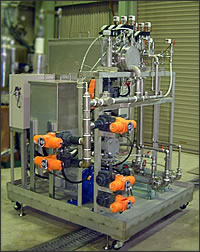
A hydrocyclone (liquid cyclone) injects treatment solution into stationary equipment to perform separation, classification, and concentration, and is an innovative separator with a very simple structure and no drive unit.
Structure of a hydrocyclone (liquid cyclone)
A suspension containing fine particles of several micrometers or more is supplied to a cylindrical container circumferentially at high speed. And as a result it starts to rotate and a centrifugal force is generated. At this time a gravitational acceleration of several tens of thousands of G is generated in the circumferential direction, and thus leading to fast sedimentation and concentration of the fine particles. The separated concentration can be freely selected by changing the supply rate (supply pressure and flow rate) and the flow ratio of the outlet. Our hydrocyclone (liquid cyclone) was designed and manufactured to classify and concentrate fine particles, and so has a small element.
THREE:Pitt, in a series of motions and violent debates on them¡ªwhich did not terminate till the 23rd of January, 1789¡ªnot only carried his point, that Parliament should assert the whole right of appointing a regent, but he contrived to tie down the prince completely. On the 16th of December Pitt moved three resolutions¡ªthe third and most material of which was, that it was necessary that both Houses should, for the maintenance of the constitutional authority of the king, determine the means by which the royal assent might be given to an Act of Parliament for delegating the royal authority during the king's indisposition. After most determined opposition by the Whigs, he carried the whole of these resolutions, and it was then moved that the proper mode of doing this was to employ the Great Seal just as if the king were in the full exercise of his faculties. To prepare the way for this doctrine, the lawyers in Pitt's party had declared that there was a broad distinction between the political and the natural capacity of the king; that, as the king could do no wrong, so he could not go politically, though he might go naturally, mad; that therefore the king, in his political capacity, was now as fully in[345] power and entity as ever, and therefore the Great Seal could be used for him as validly as at any other time. In vain did Burke exclaim that it was "a phantom," "a fiction of law," "a mere mummery, a piece of masquerade buffoonery, formed to burlesque every species of government." In the midst of the debate Mr. Rushworth, the young member for Newport, in Hampshire, standing on the floor of the House, exclaimed, in a loud and startling tone, "I desire that gentlemen of more age and experience than myself will refer to the glorious reign of George II. Let them recall to their memory the year 1745. Suppose that great and good king had lain under a similar affliction of madness at that period, where are the men, much less a Minister, that would have dared to come down to that House, and boldly, in the face of the world, say that the Prince of Wales had no more right to the regency than any other subject? The man or Minister who could have dared to utter such language must henceforward shelter in some other place than in the House of Commons, and in some other country than England!" The Prince of Wales, by letter, complained of the want of respect shown to him, but Pitt carried the resolution regarding the Great Seal, that it should be appended to a commission for opening Parliament, it now occupying the position of a convention, and that the commission should then affix the royal assent to the Bill for the regency. This done, he consented to the demand for the appearance of the physicians again before proceeding with the Bill, and the physicians having expressed hopes of the king's speedy recovery, on the 16th of January Pitt moved the following resolutions:¡ªThat the Prince of Wales should be invested with the royal authority, subject, however, to these restrictions, namely, that he should create no peers; that he should grant no place or pension for life, or in reversion, except such place as in its nature must be held for life, or during good behaviour; that the prince should have no power over the personal property of the king, nor over the king's person or household; that these two latter powers should be entrusted to the queen, a council being appointed to assist her in these duties by their advice, but subject to her dismissal, and without any power of alienation of any part of the property. The bad character of the prince, combined with the rumours of his indecent jests at the expense of his unhappy parents, rendered the restrictions universally popular.
Equipment costs can be reduced.
Operating costs can be reduced.
Maintenance costs can be reduced.
Any change in raw material and product can be easily addressed.
Large amounts can be treated in a small area.
Separation and cleaning are easy because of the simple structure.
Simplified control
This equipment can be operated in synchronization with external devices.
Alarm and interlock mechanism.
THREE:A great proportion of these results had been produced by the rapid growth of manufactures. The introduction of steam, and the inventions of the spinning-jenny and other kinds of machinery, had given such a development to manufactures, that the value of these at the end of the reign made three-fourths of the whole exports. Agriculture had made considerable progress, and of this art the king was a zealous patron, especially of the improvements in the breed of sheep, importing himself merinos from Spain at great cost. There were also great promoters of improvements in stock, such as Bakewell, Culley, and others, and the high price of corn and of all kinds of agricultural produce during the war acted as stimulants to farming. The value of land also caused the enclosure of vast tracts, and much planting of trees was done, especially in Scotland, which had previously been very neglectful in that respect.
Classification and concentration for the manufacture of inorganic powder materials
Classification of ceramic materials
Removal of fine particles, including iron powder
Removal of fine particles from pigments
Removal of fine organic particles from solvents
Separation of starch and yeast
Removal of fine particles from high-temperature strong acid solutions
Removal of fine particles from low-temperature solutions